

Showing posts with label Information Graphics. Show all posts
Showing posts with label Information Graphics. Show all posts
18/01/2010

03/11/2009
A. Michael Noll & others - Simulated Basilar Membrane Motion (1966)
Produced at Bell Labs in 1966 by Robert C. Lummis, A. Michael Noll and Man Mohan Sondhi.
"The basilar membrane is a pseudo-resonant structure that, like strings on an instrument, varies in width and stiffness. The "string" of the basilar membrane is not a set of parallel strings, as in a guitar, but a long structure that has different properties (width, stiffness, mass, damping, and the dimensions of the ducts that it couples to) at different points along its length. The motion of the basilar membrane is generally described as a traveling wave. The parameters of the membrane at a given point along its length determine its characteristic frequency (CF), the frequency at which it is most sensitive to sound vibrations. The Basilar membrane is widest (0.42–0.65 mm) and least taut at the apex of the cochlea, and narrowest (0.08–0.16 mm) and most taut at the base. High-frequency sounds localize near the base of the cochlea (near the round and oval windows), while low-frequency sounds localize near the apex." - Wikipedia.
This movie is to be viewed with eyes crossed to produce a 3-Dimensional visual effect.


22/09/2009
Ukichiro Nakaya - Snow Crystals: Natural and Artificial (1954)
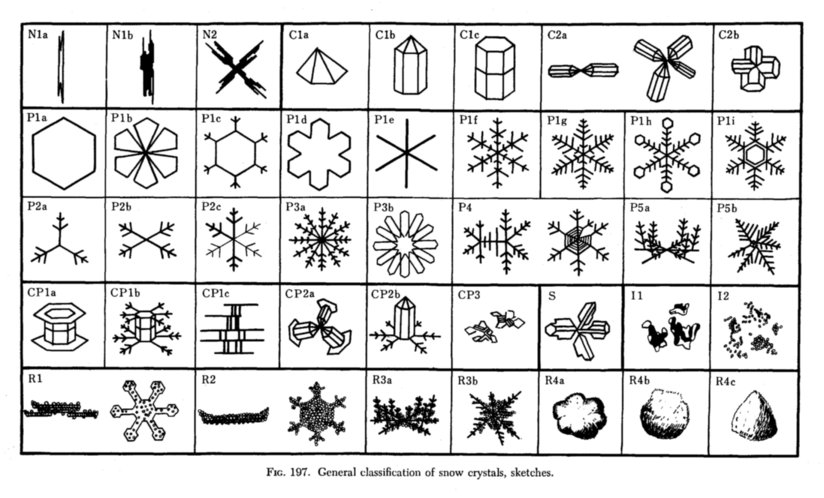 Nuclear physicist Ukichiro Nakaya was the first person to grow artificial snowflakes in a laboratory and to perform a true systematic study of snow crystals.
01/09/2009
NASA - Glass Cockpit Design (2000)
 Eleven new full-color, flat-panel display screens in the shuttle cockpit replace 32 gauges and electromechanical displays and four cathode-ray tube displays. The new "glass cockpit" is 75 pounds lighter and uses less power then the older model, and its color displays provide easier pilot recognition of key shuttle functions. The new cockpit is expected to be installed on all shuttles in the NASA fleet by 2002, and it sets the stage for the next cockpit improvement planned to fly in 2005: a "smart cockpit" that reduces the pilot's workload during critical periods. During STS-101, Atlantis will fly as the most updated shuttle ever, with more than 100 new modifications incorporated during a ten-month period in 1998 at Boeing's Palmdale, Calif., shuttle factory. View the source and other glass cockpit designs HERE.

Subscribe to:
Posts (Atom)
