

29/08/2009
28/08/2009

27/08/2009
Display Copy Mix
Part 5 - Unordinary Realities

An obscure selection of ethnic noise drone, melodies from the collected unconscious... a hypnagogic megamix by Konx-om-Pax.
1. Burning Star Core - Beauty Hunter
2. Oneohtrix Point Never - Terminator Lake
3. The Skull Defekts - Skull & Tounge
4. Valet - Rainbow
5. Alan and Richard Bishop - Space Prophet Dogon
6. Wally Badarou - Voices
7. Boards of Canada - Sac
8. Limonious - Swedish Pommak
9. KGB MAN - Castles In The Sky
10. Transllusion - Unordinary Realities
11. Scientist - Dematerialise
12. Oneohtrix Point Never - Physical Memory
13. A Blaze Colour - Nowhere Else (Zero Charisma Remix)
14. KGB MAN - Be Real
15. Hudson Mohawke - Star Crackout
"Cybernetic Serendipity" exhibition, ICA, London (1968)
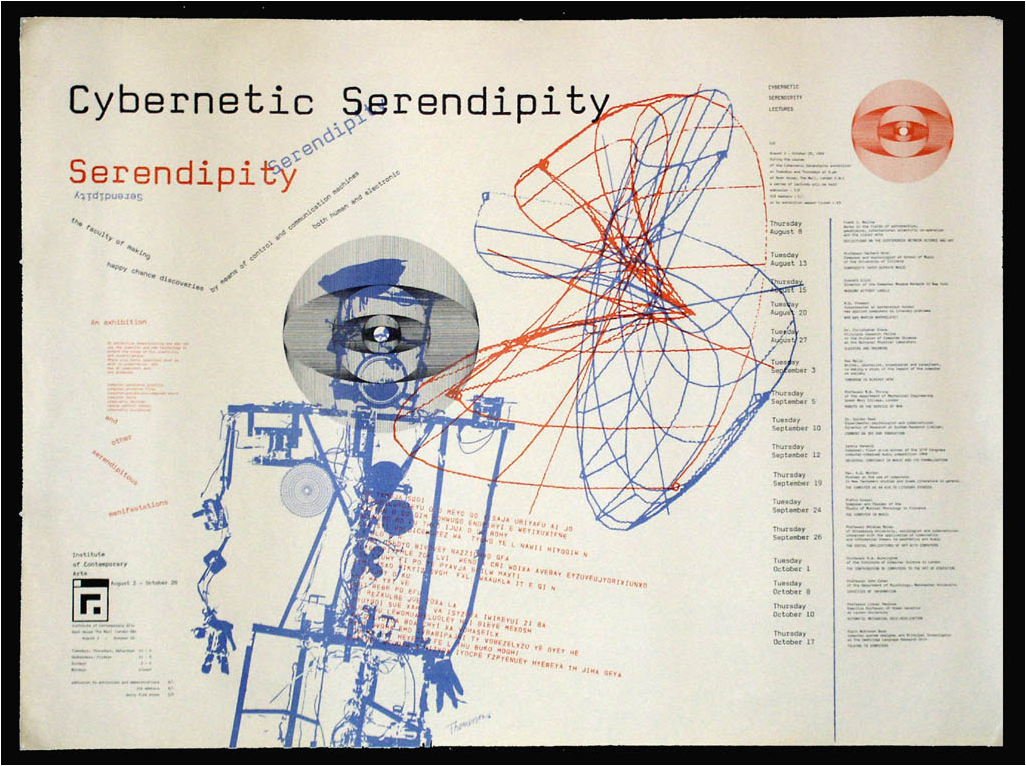
Press Release for the exhibit curated by Jasia Reichardt at the ICA London August 2nd to October 20th, 1968:
«Cybernetics - derives from the Greek «kybernetes» meaning «steersman»; our word «governor» comes from the Latin version of the same word. The term cybernetics was first used by Norbert Wiener around 1948. In 1948 his book «Cybernetics» was subtitled «communication and control in animal and machine.»
The term today refers to systems of communication and control in complex electronic devices like computers, which have very definite similarities with the processes of communication and control in the human nervous system. A cybernetic device responds to stimulus from outside and in turn affects external environment, like a thermostat which responds to the coldness of a room by switching on the heating and thereby altering the temperature. This process is called feedback. Exhibits in the show are either produced with a cybernetic device (computer) or are cybernetic devices in themselves. They react to something in the environment, either human or machine, and in response produce either sound, light or movement.
Serendipity – was coined by Horace Walpole in 1754. There was a legend about three princes of Serendip (old name for Ceylon) who used to travel throughout the world and whatever was their aim or whatever they looked for, they always found something very much better. Walpole used the term serendipity to describe the faculty of making happy chance discoveries.
Through the use of cybernetic devides to make graphics, film and poems, as well as other randomising machines which interact with the spectator, many happy discoveries were made. Hence the title of this show.»
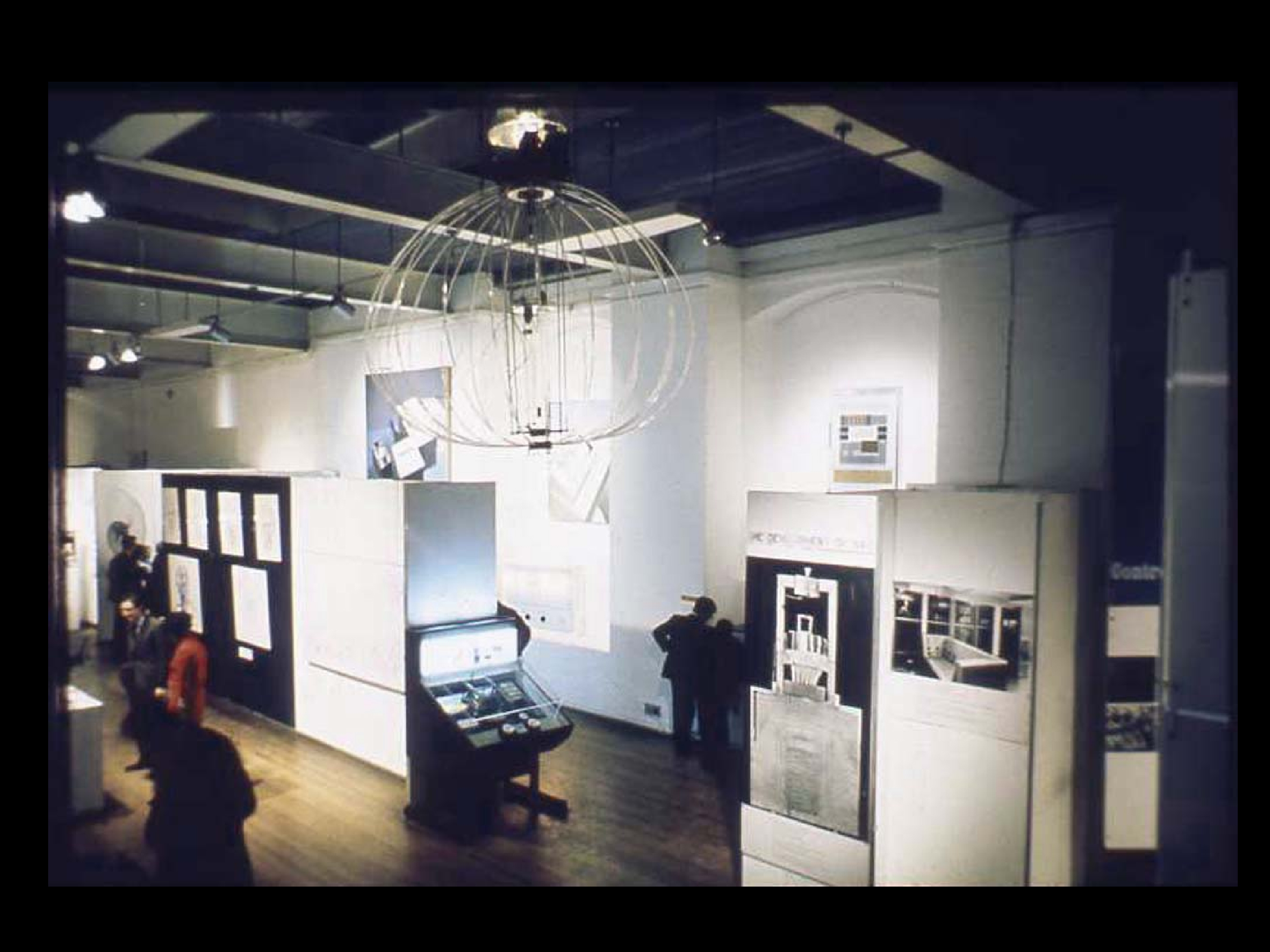
London 1968 Statement by the curator, Jasia Reichardt:
«One of the journals dealing with the Computer and the Arts in the mid-sixties, was Computers and the Humanities. In September 1967, Leslie Mezei of the University of Toronto, opened his article on «Computers and the Visual Arts» in the September issue, as follows: «Although there is much interest in applying the computer to various areas of the visual arts, few real accomplishments have been recorded so far. Two of the causes for this lack of progress are technical difficulty of processing two-dimensional images and the complexity and expense of the equipment and the software. Still the current explosive growth in computer graphics and automatic picture processing technology are likely to have dramatic effects in this area in the next few years.»
The development of picture processing technology took longer than Mezei had anticipated, partly because both the hardware and the software continued to be expensive. He also pointed out that most of the pictures in existence in 1967 were produced mainly as a hobby and he discussed the work of Michael Noll, Charles Csuri, Jack Citron, Frieder Nake, Georg Nees, and H.P. Paterson. All these names are familiar to us today as the pioneers of computer art history. Mezei himself too was a computer artist and produced series of images using maple leaf design and other national Canadian themes.
Most of the computer art in 1967 was made with mechanical computer plotters, on CRT displays with a light pen or from scanned photographs.
Mathematical equations that produced curves, lines or dots, and techniques to introduce randomness, all played their part in those early pictures. Art made with these techniques was instantaneously recognisable as having been produced either by mechanical means or with a program. It didn't actually look as if it had been done by hand.
Then, and even now, most art made with the computer carries an indelible computer signature. The possibility of computer poetry and art was first mentioned in 1949. By the beginning of the 1950s it was a topic of conversation at universities and scientific establishments, and by the time computer graphics arrived on the scene, the artists were scientists, engineers, architects.
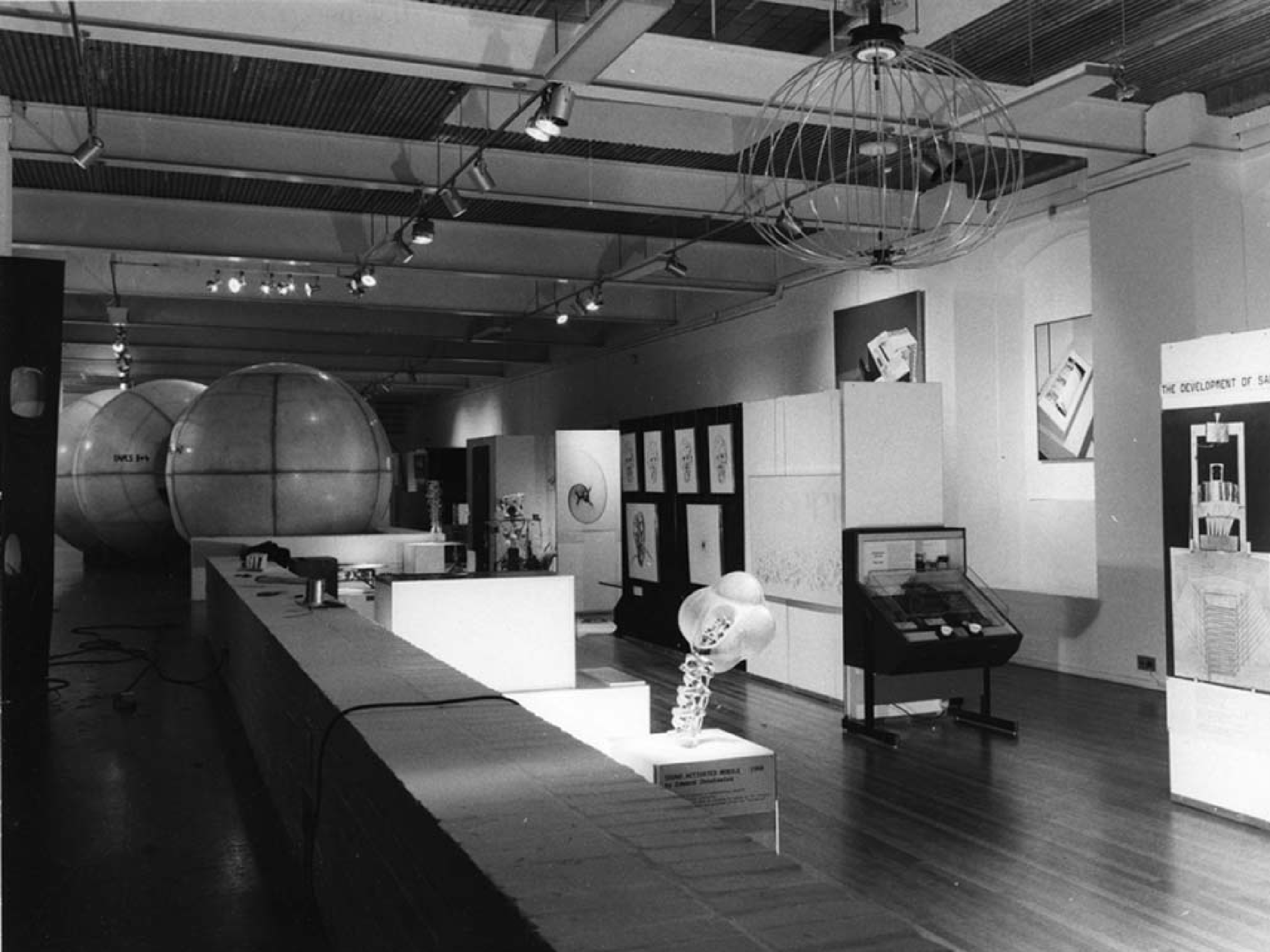
Computer graphics were exhibited for the first time in 1965 in Germany and in America. 1965 was also the year when plans were laid for a show that later came to be called «Cybernetic Serendipity,» and presented at the ICA in London in 1968. It was the first exhibition to attempt to demonstrate all aspects of computer-aided creative activity: art, music, poetry, dance, sculpture, animation. The principal idea was to examine the role of cybernetics in contemporary arts.
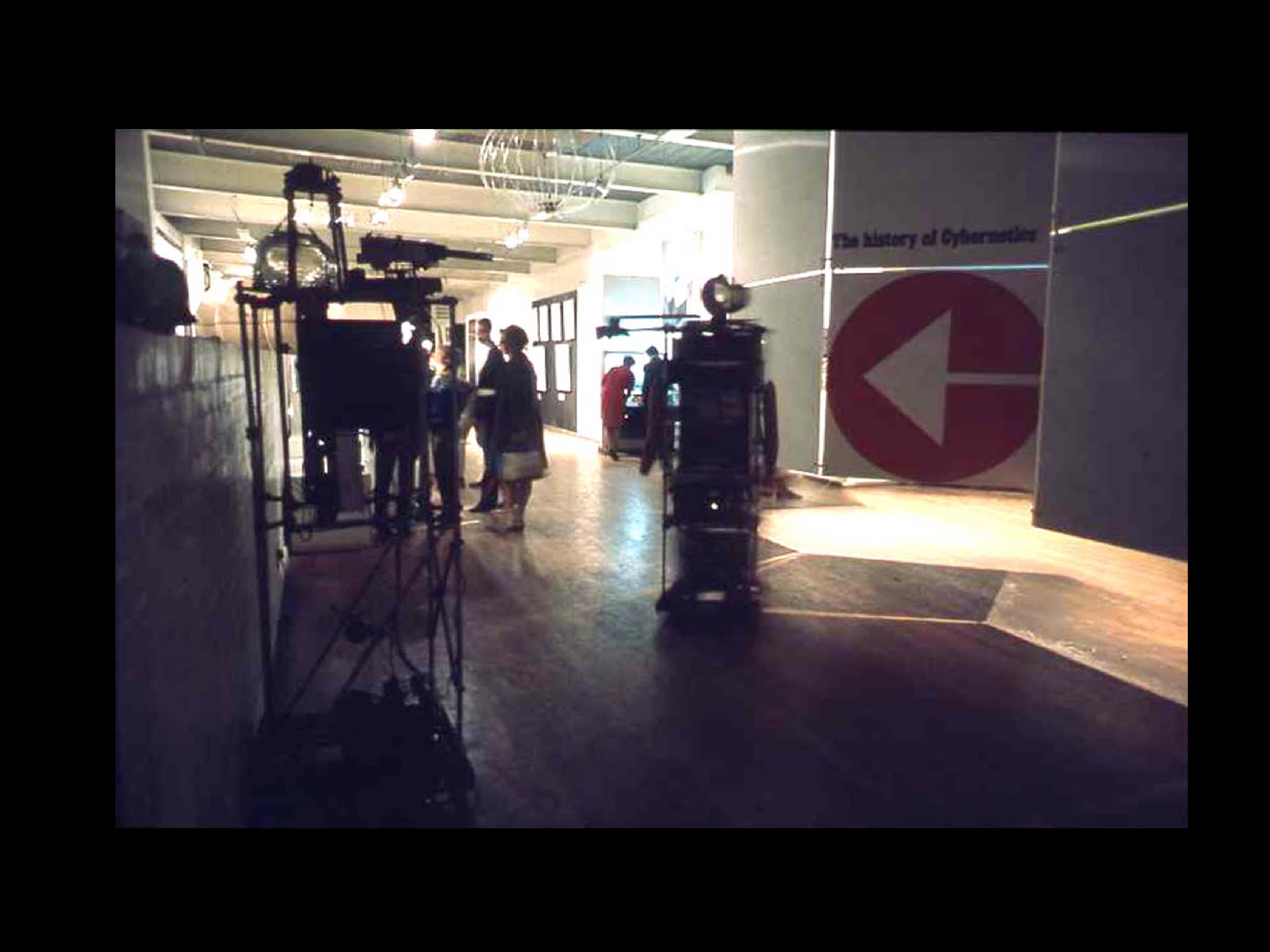
The exhibition included robots, poetry, music and painting machines, as well as all sorts of works where chance was an important ingredient.
wiki
Bolivian Deforestation

Bolivian Deforestation
Image taken 8/1/2000
Once a vast carpet of healthy vegetation and virgin forest, the Amazon rain forest is changing rapidly. This image of Bolivia shows dramatic deforestation in the Amazon Basin. Loggers have cut long paths into the forest, while ranchers have cleared large blocks for their herds. Fanning out from these clear-cut areas are settlements built in radial arrangements of fields and farms. Healthy vegetation appears bright red in this image.
This deforestation can be found on Landsat 7 WRS Path 230 Row 72, center: -17.35, -62.18.
John Carpenter - "Escape from New York" (1981)

wiki
official John Carpenter website minisite
Music composed and performed by
John Carpenter in association with Alan Howarth
Recording, editing, sequencing and synthesizer programming
by Alan Howarth at Pi West Studio.
INSTRUMENTS USED
Prophet-5
ARP Quadra
ARP Avatar (2)
ARP Sequencer
Roland CSQ-600 Sequencer
Sequential Circuits 700 Programmer
Roland SVC-350 Vocoder
Linn LM-1 Drum Computer
Fender Jazz Bass
Fender Stratocaster
RECORDERS AND EQUIPMENT
Stephens 821-A 24 trk
Tascam 80-0 8 trk
dbx 155 Noise Reduction System (2)
Otari 5050B 2 trk
Nagra IV-S
Tapco 7424 & 7416 Mixing Consoles
Eventide 949 Harmonizer
Eventide 1748 DDL
Furman PQ-6 Parametric Equalizer
Furman RV-1 Reverb (2)
Technics Cassette
MXR DDL
26/08/2009
Various - Template Exhibition (2008/2009)
‘Template’ presents current tendencies in visual media by interdisciplinary artists working in the fields of digital music, generative art and graphic design. The project features exclusive editions of high quality fine art prints alongside supported digital imagery exhibited on digital photo frames.
The 500x700mm Giclée prints are printed on 310gsm Photo Rag Satin archival paper in strictly limited numbered editions of 20. For enquiries on availabilty and pricing please contact joe@qubik.com.
Curated by Joe Gilmore and Christopher Murphy.
Visit the site HERE.
The 500x700mm Giclée prints are printed on 310gsm Photo Rag Satin archival paper in strictly limited numbered editions of 20. For enquiries on availabilty and pricing please contact joe@qubik.com.
Curated by Joe Gilmore and Christopher Murphy.
Visit the site HERE.


PUMA (Programmable Universal Machine for Assembly) Robotic Arm

The PUMA (Programmable Universal Machine for Assembly, or Programmable Universal Manipulation Arm) is an industrial robot arm developed by Victor Scheinman at pioneering robot company Unimation. Initially developed for General Motors, the PUMA was based on earlier designs Scheinman invented while at MIT and Stanford University.
Unimation produced PUMAs for years until being purchased by Westinghouse (ca. 1980), and later by Swiss company Stäubli (1988). Nokia Robotics manufactured about 1500 PUMA robots during the 1980s, the Puma-650 being their most popular model with customers. Nokia sold their Robotics division in 1990.
In 2002, General Motors Controls, Robotics and Welding (CRW) organization donated the original prototype PUMA robot to the Smithsonian Institution's National Museum of American History. It joins a distinguished collection of historically important robots that includes an early Unimate and the Odetics Odex 1.

25/08/2009
Fourier Telescope

In 1868, Hippolyte Fizeau realized that the lenses and mirrors in a telescope perform a physical approximation of a Fourier transform. He noted that by using an array of small instruments it would be possible to measure the diameter of a star with the same precision as a single telescope which was as large as the whole array — a technique which later became known as astronomical interferometry.
In a 2008 paper, Tegmark and Zaldarriaga proposed a telescope design that dispenses altogether with the lenses and mirrors, relying instead on computers fast enough to perform all the necessary transforms. His concept is an all-digital telescope with an antenna consisting of a rectangular grid. Building radio telescopes this way should become feasible within a few years if Moore's law continues to hold. Eventually optical telescopes could also be built this way. This technique is already being used in radar applications.
More on Aperture synthesis HERE
BBC Radiophonic Workshop - BBC Sound Effects No. 26 / Sci-Fi Sound Effects (1981)
 Featuring "The Core, A Huge Evergrowing Pulsating Brain which Rules from the Centre of Ultraworld" by Richard Yeoman-Clark & Elizabeth Parker plus sounds by Dick Mills and Lloyd Silverthorne.

Subscribe to:
Posts (Atom)